Feeds:
Posts
Comments

Posts Tagged ‘Family History’

One mystery is completely solved. We now have a labelled copy of the 1892 photo of the whole James Beatty family, and yes, the baby is Rupert and Charles Gordon is on the far right! Also the earlier photo was apparently taken in Dublin, which narrows the window of opportunity for the family to have travelled to Australia. Many thanks to Jocelyn, grand-daughter of Alfred Joseph for permission to include her family photos here, and also to the Charles Gordon branch for photos of him.

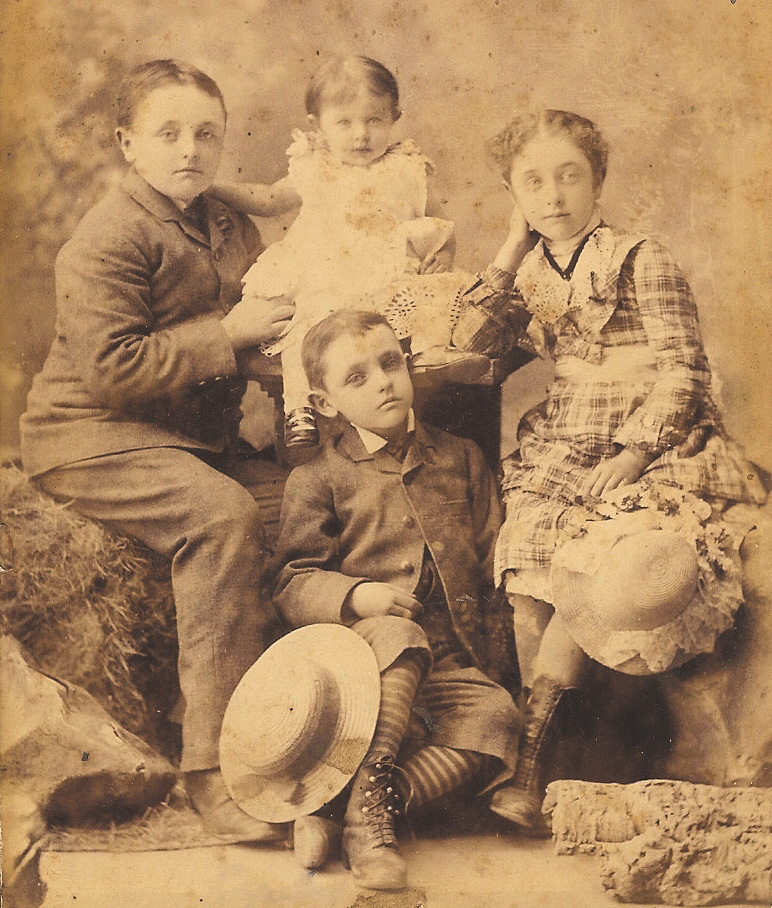
James, Kathleen and Emma Beatty above, and Archie Beatty sitting in front, Melbourne about 1884

This is my favourite of the photos Jocelyn sent, as one of Archie’s grandsons looked so comically like him at the same age.
I’ve revamped the Beatty page of the image gallery with all the new photos, and rewritten the relevant parts of the chapter of the story “The Beattys out of Ireland“. I haven’t uploaded the revamped family tree yet but will get there. I think I’ll write a new chapter about the Pagets next.
It would be wonderful if we could get in touch with the heirs of the eldest Beatty, James Paget (Jim) as apparently they have Marcella’s own Bible and the 1835 document appointing her father James Paget a JP! A letter from Janet Godfrey to Pag Beatty listed Marcella’s entries in the Bible. Mostly this was information already known, but included details such as Archie having been born at Kinard Lodge in Enniscrone and Marcella Constance Isobel having died aged 4 weeks at Woolpress Farm, Baddaginnie, presumably on a visit to her grandmother. All this information is now included in The story and will be in the family tree when I update it.

Read Full Post »

So what did I find out about the Pagets after two weeks of hard work?

Well on the male side our Paget family tree now goes back two generations further than gentleman James of Kinard Lodge (1803-72). I have discovered that he had two brothers who didn’t live to adulthood and four sisters who did, one being another Marcella. They all seem to have been born at Knockglass House.  His father James Paget of Knockglass (1749-1826) was a very conscientious father. For each of his four daughters there is a document at the Registry of Deeds making sure she will be well provided for if she should outlive her husband, and two of their marriages were important enough to be mentioned in Burke’s or Walford’s. One of the missing marriages is his own though. None of his children were born until he was fifty. The mother of two of them is Margaret Cummins, her name appearing after his in the birth entries in the Crossmolina parish register as though they are not married? Surely they must have been though for his daughters to marry so well. Was she the mother of all his children including our James?

They were a very in-bred lot. James of Knockglass’s younger brother married Catherine Orme, his Aunt Margaret had married Edward Orme, his grandmother (I think) was Margaret Orme and his youngest daughter  Marcella (the Aunt of our Marcella) married another Edward Orme. If there wasn’t an Orme to marry they even married each other. His eldest daughter Margaret Paget married her cousin Thomas Paget.

The most annoying missing marriage is the one I was determined to find between James Paget and Hannah Dempsey and I’ve looked everywhere.  James was definitely married in 1829 to Catherine Benson though they seem to have been childless.  I think I mentioned in a previous post the document I found at the Registry of Deeds dated 1849 between James Paget and Charles Benson which I (very roughly and possibly wrongly) translate as “I’ll give you a couple of Townlands if you’ll take your daughter back”. Opinions are divided among the experts I’ve consulted here as to whether James would have been allowed to marry again with a living wife. Divorce as such wasn’t recognised then though I’m told “There were ways and means”. He certainly made up for lost childbearing time with Hannah, married or not. Our Marcella was the eldest of five.

In short I found out both much more and much less than I had hoped. Half an answer leads to two more questions. No wonder people who get sucked into family history spend the rest of their lives at it! Anyway I think I’m over the Pagets for the time being. If I come back to Ireland I’ll try the Beattys.


Read Full Post »

Left Dublin at 9.30 this morning in a little Suzuki hatch, switching the wipers on and off instead of the indicators. It was more annoying than usual because I then couldn’t see since it was raining. Drove through several indistinguishable counties, though the scenery got progressively more interesting through the morning with lakes and finally as I reached Co. Sligo, some actual hills. After 4 hours I reached Enniscrone, where Archie Beatty was born.

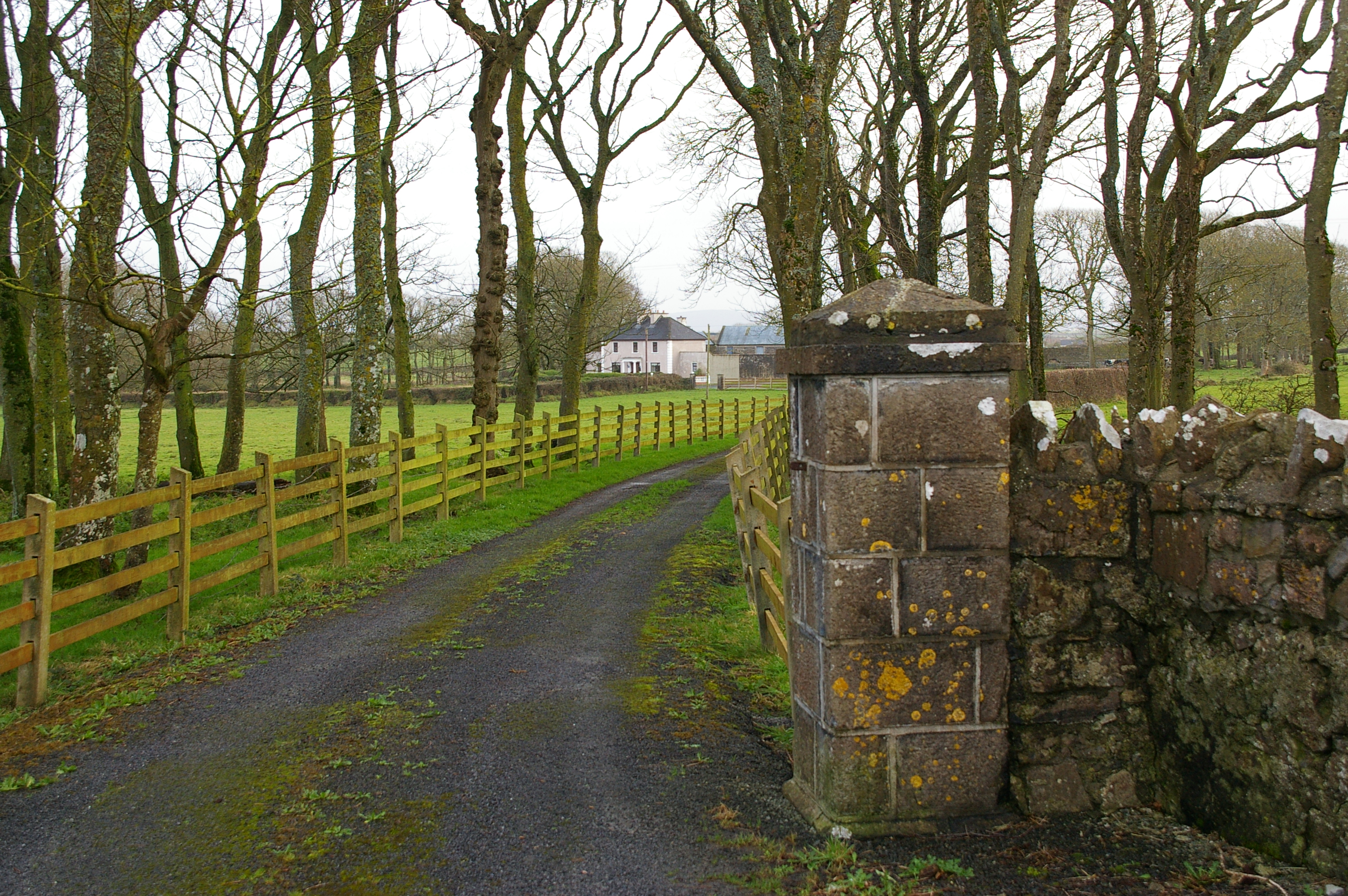
The first visit was to Kinard Lodge to take some photos.

Kinard Lodge, Enniscrone, Sligo with gate and drive

The nice lady who currently owns it, Mrs. Mary Judge was really interested in the history of the house and invited me in for a chat and showed me around. The inside was completely renovated about 30 years ago and only the windows, deeply inset in the stone walls still look Georgian but the sheds and gates outside look original.

Next I went to Kilglass Church, wrestled open the big cast iron gates and found James Paget’s tombstone. It’s now very hard to read, and like everything in Ireland, covered in moss.

Apparently the person to talk to is a Mrs Mac Hale who knows the whole history of Enniscrone. I might see her tomorrow. Some friendly locals were interested to help trace the Pagets, but quickly concluded “Oh They’d have been the Landlords. The enemy! We wouldn’t know anything about them!” only half joking after 150 years.

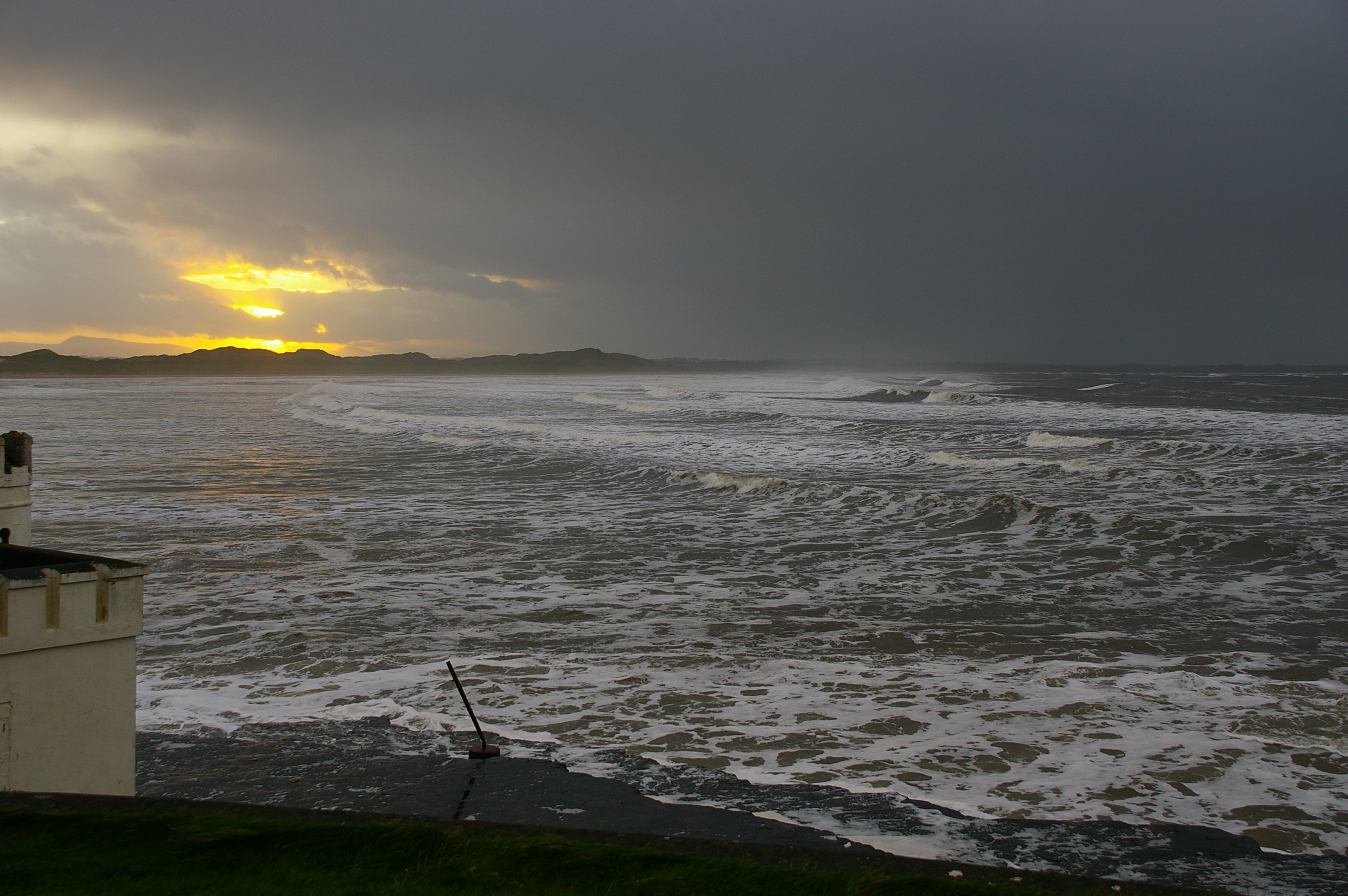
Enniscrone is a seaside town, the stone buildings still huddled along the original narrow road through the town,  probably little changed since the Beattys and Pagets left in 1877. The beach is very wide at low tide and pretty impressive even to Australian eyes, and this afternoon a fierce surf was rolling in from the Atlantic driven by a bitingly cold breeze.

Killala Bay from Enniscrone, cold November afternoon

I hope conditions were milder when Captain Matthew Webb swam across Killala Bay from here. According to the story he was accompanied by James Beatty’s father James. I wonder if there’s a grain of truth in that or if it’s another family myth?

Read Full Post »

I went on a bus tour on Sunday when the Libraries and Archives were closed, and I hiked right across town via Dublin Castle and Chester Beatty Library with books and manuscripts from antiquity which should be really interesting some other time. I was thinking Dublin is a very grey place, until for a few hours the sun came out one day, and then I discovered the Registry of Deeds.

I’m glad I did so much homework before leaving because the amount of genealogical resources here is astounding. Given sufficient time here I could probably even work out the Beattys. This trip I’m focussing on the Pagets though, and since they were landholders, there’s an unexpected place that I’ve found out quite a lot more about them, although not always what I was expecting to find. All the stuff in the Registry of Deeds escaped the Four Courts fire of 1922 which destroyed so many Irish records.  It’s mostly about Land purchase and agreements to do with property, marriage settlements etc. going back to 1705, all couched in abstruse legalese, but full of genealogical information all the same. What’s really fun is the place itself though.

The indexes to the deeds, and hand written copies of every one are in thousands of enormous books referred to as “tombstones” – giving you an idea of their size and weight. The earlier ones are written on skin of some kind, and many are leather bound, once beautiful but suffering badly from over-handling. Most have been given hessian covers with their numbers stencilled on them like wool bales. The “tombstones” are arranged in special pigeon holes all around the walls of several large rooms up to about 4 metres high. It’s all self serve once the system is explained, so you have to climb up and down tight spiral staircases and lug these things up and down ladders to consult them. You sit on high stools to read them like Uriah Heep in illustrations by Phiz. I’d have loved to take photos, but it isn’t allowed.

I’m sure now that  James Paget of Knockglass who purchased Kinard townland in 1810 is the father of Marcella’s father James Paget who built and lived in Kinard Lodge. Two documents that I’m having copied make this clear, though I still don’t know his mother ‘s name. Also, James Paget of Kinard Lodge married a Catherine Benson in 1829, who was still alive and married to him 20 years later only 4 years before Marcella was born whose mother, and the mother of all James’s children was Hannah Dempsey, not Catherine. There’s a particularly abstruse document from 1849 that might be some sort of separation agreement between James and his first wife. In 1867 James seems to be entailing Kinard to others  because he has no legitimate heirs, at a time that Marcella and at least two of her brothers were well on the scene. Not sure what to make of that yet. I could go off on a tangent researching Irish marriage and heredity laws but might shelve that issue until I get home.

Read Full Post »

A few leads have emerged which I haven’t got around to documenting here yet but I’m too impatient to keep on waiting to get information out of Ireland page by painful page when I can see how much of  it is right there in the National Archives and National Library in Dublin. Good grief I could spend the equivalent of the airfare in dribs and drabs before getting noticeably further so why not just go? Good excuse eh? I booked the flights this morning.

We knew that James Beatty had a drapery business in Ballina, Mayo in 1876 and that his two eldest children were born in Arran street Ballina in 1874 and 1875.  No James Beatty owned or leased land in Ballina, or anywhere in Mayo for the Griffiths Valuation, but somewhere between 1857 and 1863,  No. 5 Arran street was leased by, not a James, but an ARCHIBALD Beatty.  Now there’s a familiar forename.  Slater’s directory of 1870 has the following business addresses for Beattys in Ballina:

Under Linen & Woollen Drapers & Haberdashers:  James Beatty, Knox street

Under Grocers; Leather sellers and as an Auctioneer: Archibald Beatty, Arran street

As there’s no James Beatty leasing in Arran street where his children were born, and his business is in Knox street, it’s quite likely that the family lived at 5 Arran street with Archibald. Living with extended family was quite common back then. Was Archibald James’s uncle or his brother perhaps?

My other lead is about the Pagets. One source I’ve seen recently has Kinard being originally purchased in 1810 by “James Paget of Knockglass”. Our James Paget was only 7 in 1810, so who is this James Paget? His father? His Uncle? I think at least it does prove that our Pagets are the same family as the Pagets of Knockglass, Crossmolina.

Remember the Beatty brother and three sisters who lived at Enniscrone, County Sligo, the last of them dying only 3 years before Peg Beatty went looking for our forebears there in 1953? Someone posted here who is definitely related to them, and to most of the other Beattys of Mayo and Sligo of the late 19th century and we’re exchanging information. Whether we are all related to each other or not remains to be established, but the more researchers trying to sort out the Beattys the better. Thanks for your help new contact!

Read Full Post »

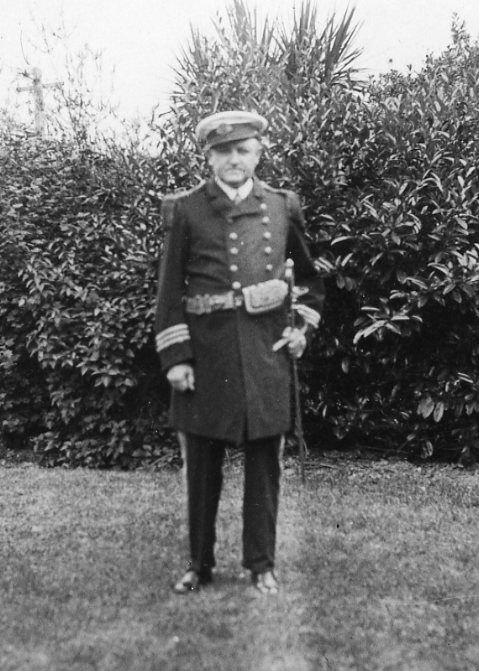
Everyone in our family knows that we are related to the glamorous hero of the First World War Battle of Jutland. When I asked my father how he knew, he said “Oh, everybody knows that!” His father Archie had a beautifully framed and labelled large photograph of “Admiral Beatty on board his flagship watching the surrender of the German fleet”. Which obviously proves it 🙂

"Admiral" Archibald Beatty c. 1930

Unfortunately I’m sure this is one of those family myths. The well documented family tree of the famous Earl goes back through many generations of soldiering Anglo-Irish gentry whose family mansion was Borodale in County Wexford in the far south-east of Ireland. On completely the other side of Ireland in County Fermanagh in the 17th century a lot of Scottish borderers were settled as tenant farmers, many of them named Beatty. You can tell that our Beattys were originally Scottish because James Beatty (born 1842 Co. Fermanagh, father a farmer) was both married and buried a Presbyterian. The family of his wife Marcella (the Pagets) were Anglican though as were his children. I’m afraid it’s highly unlikely that any relation of David Earl Beatty wandered up to Fermanagh or Mayo to take up farming or shop keeping with the Presbyterian Beattys up there.

I think the fun-loving Archie Beatty is the culprit. While I can find no mention at all until the mid 1920s that we are supposed to be related to County Wexford Irish gentry on the Beatty side, once the fame of David Beatty spread, Archie started to sign himself “Admiral” and kept notes from his friends where he is addressed as “Skipper”, “Admiral of the Fleet” and even “Earl”! I suspect it was fun to assume a relationship based on shared name and Irish ancestry and never mind the boring details. He is even on record dressed for the part! He has certainly made it difficult for family historians among his descendants though. What killjoys we are!

Read Full Post »

It’s becoming clear why the Pagets left for Australia. Not sure what it says for my research skills that my best discoveries are through serendipity though.  I was on HAGSOC duty the other day (that’s my local family history society), filling in a spare minute or two browsing a recent issue of  “Irish roots” when an article caught my eye: “The rise and fall of County Sligo landowning families” by John C. McTernan. The Pagets are not mentioned by name as some of the larger landowners are, but the following quote very likely applies to them:

“As the 19th century progressed several estates found themselves in serious financial difficulties arising from extravagant living, over ambitious house building activities and more especially a loss of rental revenue in the aftermath of the famine. The introduction of the Encumbered Estates Court in 1849 and the Landed Estates Court a decade later facilitated the sale of encumbered estates. Between 1850 and 1876 a total of seventy-seven estates or portions thereof changed hands within the county.”

Following the death of our James Paget, first his elder son James Reginald in 1876, followed in 1878 by his wife Hannah, second son Charles Thomas Stavely and his eldest daughter Marcella with her husband James Beatty, all emigrated to Australia, and parts of their County Sligo property, at least, were offered for sale in the Landed Estates Court in 1874:

http://www.landedestates.ie/LandedEstates/jsp/estate-show.jsp?id=218

You can see Kinard Lodge on the satellite version of the map link provided by this document, but in maps with historic overlays (links on rh column of this page) you can see that in 1840 it had extensive formal gardens.  In 1814 there appears to have been no landowner’s residence at Kinard. The earliest reference  to Kinard as a residence that I can find is 1834, when it is the residence of James Paget.  He may have built Kinard Lodge sometime in the 1820s.  I don’t know about the “extravagant living” described in the article, though maintaining that garden may have cost a bit. The rest of it fits pretty well though. It would have taken a hard landlord to expect starving tenants to keep paying full rent, no matter what the debts. Spurred by a few high-handed landlords in Mayo, by the 1870s the Fenian movement was gaining ground too.  I enjoy imagining the young Paget boys saying “Dad, let’s cut our losses and emigrate. Every one else is!” and him saying “Over my dead body!” Which it turned out to be. It was probably considered a shrewd move on Marcella’s part to have married a  merchant like James Beatty.

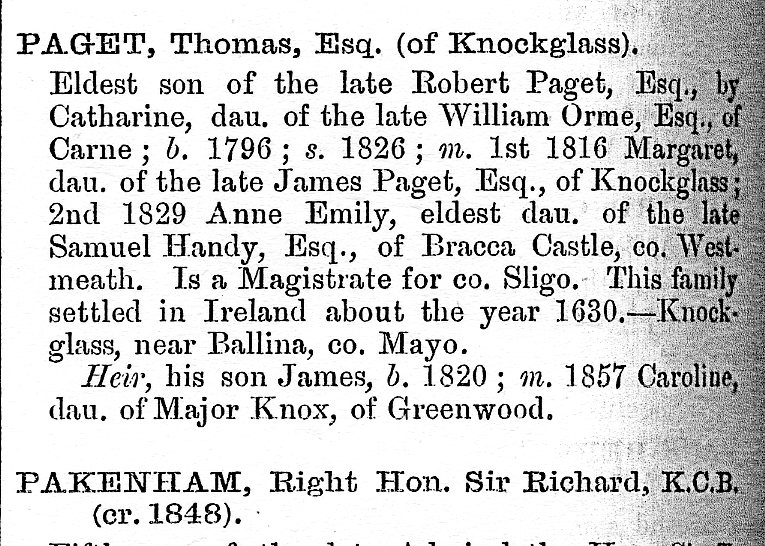
Who were James Paget’s parents?  Since he’s a “Gentleman”, it should be much easier to figure out his ancestry than it will be to get any further back with the Beattys.  The Landed Estates database (link above) refers to James and Thomas Paget as though they’re related, as they almost certainly must be. Unfortunately all the references that might confirm this are unobtainable in Australia, although Thomas Paget of Knockglass, being the senior family member of their generation is mentioned in such sources as “The Country families of the UK” by Edward Walford, 1860:
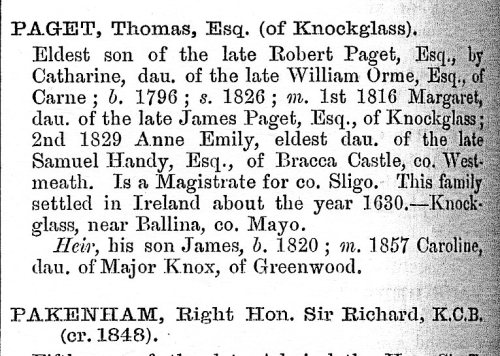
Entry for Thomas Paget of Knockglass, Crossmolina, Mayo in Walford’s “Country families of the United Kingdom and Ireland” 1860

Neither of the James Pagets mentioned here are our GG Grandfather. Our James (born 1803) is most likely the younger brother of Thomas. It’s interesting that Thomas seems to have married his cousin. That could have been to consolidate the Estate. The fragmentation of the estates due to the inheritance laws was a problem at the time. The father of our James was probably either the father of Thomas (Robert Paget)or of his wife Margaret (James Paget of Knockglass).
Kinard Lodge was taken over by a Captain John Paget Bourke after our Pagets left. I think he was a nephew of Thomas Paget, whose sister married a John Bourke. When our Aunt Peg Beatty went to Enniscrone and Ballina in 1952 in search of Beatty and Paget relations she was sent to see a “Mr Paget Bourke” of Ballina. Sadly he was not at home or all of this might have been easier!
To get much further I probably need to consult books and records which are only held in Dublin, especially at the National Library of Ireland. Anyone want to come with me?

Added 9 May 2012: My most up-to-date information on the Pagets is now part of The Forgotten Pagets of County Mayo – see the link to other chapters of the family story in the right hand column.

Read Full Post »
The first “family historian” I met was John Arthur Blackett “Jack” Forster who visited my parents in the early 1960’s to look at our family documents and returned to regale us with details of his trip to Northumberland where he spent time cross-checking our documents in parish registers at Rothbury and Alwinton. From him we first learned about the Forster ancestral home Bygate Hall, which he also visited.  He was then a retired metallurgist. My father’s cousin, he was the eldest son of Arthur Edward Blackett Forster who was the eldest son of William Mark Forster.  You can find him in my family tree (the link to it is on the rhs of home page).  I’ve copied the major documents from his research for anyone who is interested. See “Early Forster documents” under the “Image gallery” tab above. His research was methodical and accurate as far as I can tell, except for the label on the portrait discussed in the last post.

I don’t have an adult photo of Jack, but this caricature from an unspecified newspaper in his Shire Councillor days is so very much as I remember him.

Read Full Post »

« Newer Posts